
★ ★ ★ ★ ★
Words by Constance Drugeot
Most of us, if not all of us, are familiar with the harrowing 2002 movie directed by Roman Polanski and starring Adrien Brody, The Pianist, based on Władysław Szpilman’s memoirs. The heartbreaking story of a man who survived against all odds. A musician whose own music gave him a way to stay alive. An unimaginable feat.
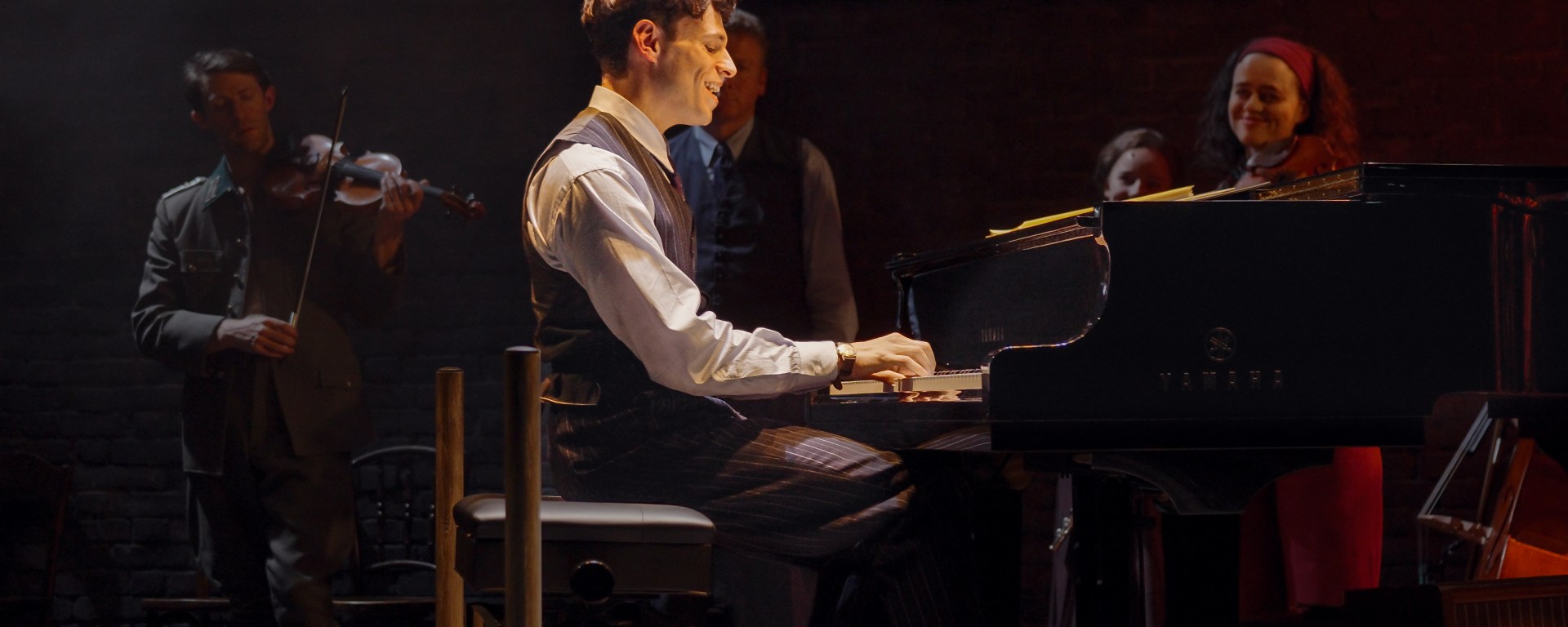
In this production, adapted and directed by Thom Southerland for the U.K. stage, we relive some of the darkest moments of humanity through Szpilman’s eyes as he narrates his own story. Starring Daniel Krikler as the brilliant musician, the play takes us deep into his memories while the music is brought to life around him through an extraordinary ensemble of actor-musicians. In the centre of the stage, the show’s own musical director, Malcolm Forbes-Peckham, sits down at the grand piano and plays.
The Pianist is not an easy story to read or watch. Yet, there is something profoundly beautiful about one man’s courage, strength, and will to live. This is what I felt watching Southerland’s play. It isn’t about the destruction or the horrors and despair; it’s about hope, it’s about the power of music throughout time, it’s about how we can best honour and remember the people we loved. It’s a poignant and devastating tribute to Szpilman’s family. It’s a story we must keep on telling, so we never forget.
What made this tribute even more moving is how Simon Lee, the show’s music supervisor, beautifully incorporated Szpilman’s own music. Malcolm Forbes-Peckham doesn’t say a word during the entire length of the play, but, dressed in his best suit, he surrounds the auditorium with music. Personifying the prowess of this talented pianist, he then lets Krikler narrate the difficult journey he went on. It’s only at the end that Forbes-Peckham leaves his seat and gives it to Krikler, who finally touches the piano keys and lets the notes echo. The lights dim all around as Szpilman reclaims his music.
Throughout the show, Daniel Krikler reminds us how powerful acting can be. A gentle and steady soul who does his best to keep up with the chaos that surrounds him. Despite warnings and several ways out, Krikler’s Szpilman chooses his family over and over again, until the choice is made for him – saving him from a tragic death. But even then, his family remains at his side. Their memory and their music keep him alive, keep him sane, help him remember, and share his story. Krikler’s interpretation is both heart-wrenching and passionate. He’s fierce in the way he loves, and he plays – or aches to play. He’s fervent in the way he doesn’t let a blind war deprive him of his kindness and integrity, but it’s also distressing to see him having to face the violence and death around him; chilling to watch him deciding whether to take his own life – and trying – instead of giving up to the Germans; and the most heartbreaking of it all is witnessing the moment he realises he will never see his family again. Krikler is a master of his craft, and it is an honour to see him embody such a character, such a strong-willed and resilient spirit.
Of course, what makes his performance whole is the talented ensemble of musicians who play around him. Composed of his family, his lost love, and a few colourful characters, the ensemble includes Rosalind Ford, TJ Holmes, Elżbieta Kalicka, Melania Maggiore, Nitai Levi, Mischa Jardine, Oliver Grant, Max Roll, Oliver Magor, and Erin Rowlatt. While they seem to hover around Krikler, like ghosts, urging him to go on and helping him patch his memories together, they continue to envelop him in music. Szpilman’s entire family were musicians, and as such, the ensemble plays the cello, violins, saxophones and more, guiding him, as always, through the darkest of times.
To top it all, I have to mention Andrzej Goulding’s stunning set design. In its simplicity, it allows the storytelling to become the driving power of the show. At its centre, a beautiful grand piano, emphasising whose story we are about to witness, and behind it, a huge “fake” brick wall where music notes are projected. As we progress through time, the wall opens up little by little from the ceiling down, revealing a warm home, a lively café, a recording studio, a terrible ghetto, a fateful train, and finally, a place where Szpilman almost met death, but in the end, found freedom. I’ve never seen such a clever way to transport us to different settings and moments.
There is no show like The Pianist. There is nothing as raw, as poignant, as fervent, and as inspiring as Władysław Szpilman’s story and the way Southerland chose to share it with the world. It’s heartbreaking yet empowering, and from the horrors, we witnessed the rise of compassion, love, and above all, hope.
The Pianists runs at the Park Theatre until November 28.

