
By Constance Drugeot
Pictures: Felix Pilgrim / Artwork: Guy J Sanders
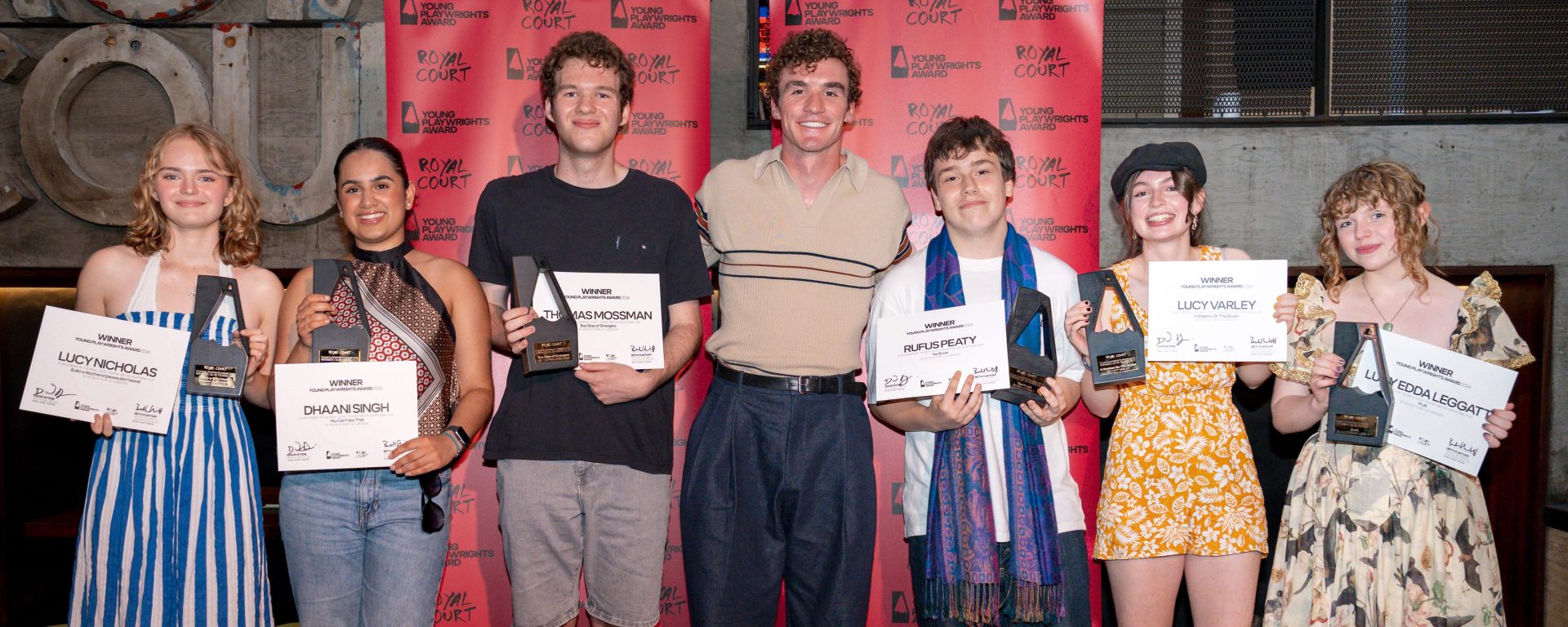
We had the great opportunity to sit down with some of the winners of this year’s Royal Court Theatre’s Young Playwrights Awards to talk about their plays, the inspiration behind their award-winning work, and their advice to aspiring young writers.
13-15 age category:
You’ll Live by Rufus Peaty
Fruit. by Lucy Leggatt
16-18 age category:
Bus Stop of Strangers by Thomas Mossman
Build-a-Boyfriend (please don’t leave) by Lucy Nicholas
Can you present yourself and tell me more about your play?
Rufus Peaty: My name is Rufus, and I wrote the play You’ll Live. It won the 13-15 category, which is really amazing. It’s about a girl who gets a dress from Vinted for an event at school. Everyone thinks the dress looks lovely on her. But she thinks there’s something dark going on with it. She starts to become convinced that something slightly more sinister is going on.
Lucy Nicholas: I’m Lucy Nicholas. I won the 16-18 age division with my play Build-a-Boyfriend (please don’t leave). Short title, I know [laughs]. It’s basically about this girl and her best friend who gets a boyfriend. She becomes very jealous of all the attention this new boyfriend is getting, to the point that she creates a boyfriend of her own. He lives in her locker, and things turn a bit dark.
Lucy Leggatt: I’m Lucy Leggatt. I won the 13-15 age category with my play Fruit. It’s about an experience of an eating disorder, and about my close female friendships. It’s about this girl who starts to be visited by these visions of the biblical figure Eve, who encourages her to stop eating. It’s about how it’s been affecting girls and teenagers throughout time, essentially.
Thomas Mossman: Hello, I’m Thomas. I was one of the 16-18 winners, and I wrote Bus Stop of Strangers. It’s a play about a father and son at a bus stop and their opposing political views and worldviews.
How was the ceremony last week? How was it to see your plays being performed?
Lucy Nicholas: That was the best! It was amazing. I think for all of us, it was a really great experience to see what we’d imagined being put on stage. Our directors were so talented, as were the actors. They did it so well. But it’s really bizarre seeing something that you imagine in your head and never really thought could go anywhere being put on stage with actors. It was amazing. The directors put their all into it, and you could really tell. Meeting the other playwrights and everyone at the Royal Court was also really awesome.
Lucy Leggatt: It was just such a surreal experience. It was crazy to see something that had been in my mind come to life on stage and have other people react to it. It was also really nice to see the decisions the directors and actors made, such as seeing different aspects of my characters or different stage directions and how they plotted things in ways I hadn’t envisioned. It was such an honour to see so much come from something that I thought was so small.
Rufus: I was so excited to see the other plays. So when we got there, I was really excited to see how mine would manifest. But also, I really wanted to know what both of the other Lucys’ plays were about. It was just so well done. And I agree with you, Lucy; seeing how it resonated with people, knowing that your writing has that much impact is a really amazing thing. It was really interesting.
Thomas: I don’t really have anything else to add to that. That was really lovely, but pretty crazy.
Where did you find the inspiration to write your play? Can you tell me why you decided to enter the award?
Lucy Nicholas: This was the first thing I’d ever written. I’ve done mandatory creative writing in school. But it was the first time I sat down and decided to devote myself to an idea and see it through. The award is what I wrote it for. I wasn’t planning to write a play before. But I found the Royal Court Theatre’s Young Playwrights Award, and I was like, “I’m just going to give it a shot because this sounds really fun”. I have loads of random ideas. If I ever think of something vaguely cinematic or something interesting happens to me, I write it down on my notes app. That’s what happened with this play. I had this sudden thought about how everyone’s so obsessed with romantic relationships, especially girls. And then I had this weird thought, like “Imagine if you got so jealous and you manifested a relationship”. I had the initial idea and motivation, then I just committed to doing it. I made a playlist. I made a rough scene plan, and I just had loads of fun writing it by myself in my bedroom. Little did I know it would kind of come to all of this!
Rufus: I’ve been writing ever since I was seven. I love theatre. And also I love the Royal Court.
My friends and I have set the goal this year to see as many plays as possible in the downstairs theatre because they have a 10-pence standing scheme. I was very inspired by John Proctor Is the Villain because I saw that before I submitted the play, and I loved how well written it was. It just really showed what you can do with writing and how much it can shock people, how much it can make people cry. I think I was a bit unsure about submitting to the competition. But then seeing that really showed me how much of an impact writing has. I think it’s just such an amazing theatre. You wouldn’t want to miss out on the opportunity to have something performed there. It encourages so much new writing and gives a voice to people who might never get the opportunity to have something performed. It’s really amazing. It’s been the chance of a lifetime.
Lucy Leggatt: I kind of do the same as Lucy. I have a notebook, and I keep every interesting thing that happens to me in it. It’s a very important part of my writing. I’ve been writing ever since I was little. It’s been my biggest passion for a long time. I do a lot of poetry. I’ve tried some different styles, but I never really considered playwriting until I wrote a short one, encouraged by my drama teacher earlier this year. He put it on with some of the students, and he was really encouraging. It just kind of gave me the confidence to try out a new style, which was really nice. And then, my mum found the competition and suggested it. I very frantically wrote Fruit., but it was never something I really envisioned until recently. It’s just kind of become such a massive part of my life thanks to the Royal Court Theatre, which is really nice.
Thomas: I think my play is a bit different to everyone else’s. My play was developed for The National Theatre’s New Views course originally, which I did last year. And then from that, I realised I had a play. I was like, “I might as well submit it for the Royal Court Awards”. And obviously it did quite well. Then it was also quite fun because David Okodeh, who wrote The Worst Part, was shortlisted. He did the same course as me. So then, getting that weird, multiverse crossover at the ceremony was lovely, to be honest with you.
Has this experience inspired you to keep writing?
Lucy Leggatt: It’s done nothing but encourage me, to be honest. It’s really crazy. I never had much confidence in my writing before, but having it recognised has really pushed me. I’m writing something similar to Fruit. at the moment, but set in the modern century. I think themes of female friendship really, really interest me. It’s a thing I’m quite passionate about, but I’ve got so many more ideas that I want to keep doing. So much left to say, really!
Lucy Nicholas: The awards just made me want to write more, if anything. It’s been a really encouraging experience because I’d never written much before. I’d sort of just convinced myself, “I’m not very good at making things”. I just consume things that other people have made because I read, like, mad. So I was like, “maybe I’m just meant to consume the content and not make it”. But the awards definitely made me want to write more things, definitely more plays. I really like the medium, and it’s a really great outlet because theatre can make you feel so much. As Rufus said, it’s so moving. One minute you can be laughing, one minute you can be crying. I think theatre’s such a great way of engaging with your audience. So it’s definitely made me want to write more.
Rufus: As our generation is the generation where AI is being pushed at, I think theatre is the most personal, human art form that there is. Because you can’t beat a room full of people listening to a story. I love a challenge, so currently, I’m writing a musical, which I’ve never done before. I’m doing it with one of my friends, which is proving very interesting. What I found so impressive about Fruit. was how you [Lucy Leggatt] managed to set it in that specific time period. The writing and the language really matched the time period. I wanted to challenge myself with that. I started looking into more historical drama, so moving away from the present.
Thomas: In terms of my play, I’m quite happy with it as it is. I am not planning to do anything else with it. Like everyone else, I’m very much continuing to write. There might be a full-length play in me to be confirmed or continued. Just keep writing, really. That’s the aim of the game.
What advice would you give to aspiring young writers?
Thomas: I think, in general, write what you know. For me, at least, it’s the main thing. I’m really nosy, and I love reading other people’s work. I think the most powerful work that I’ve ever read is people writing from their own experience.
Lucy Leggatt: My biggest piece of advice would be to keep watching plays, keep reading plays, go to the library as much as you possibly can, take out books, read books. To understand and have a knowledge of literature and theatre and any of that, you have to watch it, you have to know it. The only reason I can actually do any of it is that I’ve watched and read plays obsessively. I saw 1536 earlier this year, and it just broke me. You’ve just got to keep doing it. My mum’s a librarian, so I have constant access to as many books, plays or literally anything that I want. But really, just visit the library, keep reading, keep writing, and as Thomas said, write what you know. I think that’s the most powerful thing that you could ever tell anyone who wanted to get into it.
Rufus: I completely agree with what Lucy said. I saw a play a few weeks ago, The Oresteia at the Bridge Theatre; it was four hours long, but it was really good. It kind of ignited me. I was slightly worried as the day of the festival was coming up because it was so big. But seeing that play really inspired something in me to keep writing. My biggest piece of advice would be to go for things that you look to yourself when you’re writing. My play focuses on people who are part of the LGBTQ community, so it’s a self-discovery story. I really could resonate with that when I was writing it down. You often find that writing what you know, the experiences that are closest to you, are the ones that come off the best. I think the Royal Court really know how to pick the best plays to put on. So, when you’re seeing a show in the Royal Court, we trust.
Lucy Nicholas: I think my best bit of advice is just to do it. I was sort of convinced that I wouldn’t be able to do it, and so I didn’t try for a very long time. I think the best thing to do is to go out on a limb and think “what’s the worst that can happen” and give it a go because you’ll get a lot out of it. I think writing is a very rewarding experience.

