
By Constance Drugeot
Picture: Jeff Busby
⭐️⭐️⭐️⭐️⭐️
Note: I will use they/them for Yentl
Growing up, my mother and I used to cuddle on the sofa and watch the 1983 Barbra Streisand movie Yentl together. It was a beloved ritual that accompanied me throughout my childhood and teenage years, and something that deepened the bond we had. I fell in love with not only Barbra’s voice but also with the original short story by Isaac Bashevis Singer, written in 1962, showcasing Yentl’s courage and journey. Yentl, who, in the midst of opposition and tradition, was brave enough to be themselves and live their own truth. Unbeknownst to me, their determination and spirit had a powerful hand in shaping who I am today.
So, when the opportunity arose to see an actual adaptation of this beloved story, co-written by Gary Abrahams, Elise Hearst, and Galis Klas, I didn’t even hesitate. I booked train tickets, and I was on my way to the Marylebone Theatre. This production by the Kadimah Yiddish Theatre transferred directly from Australia, where it had a much-acclaimed run at the Sydney Opera House, for a six-week limited engagement in London. Being so excited about the prospect of seeing this tale come to life on stage, I had dragged several of my friends to see it with me, telling them about the modern aspect of the story and all the questions it raised about society, religion, tradition and identity.
For those who may not know, the story follows Yentl, a young woman who longs to study the Torah but, because of the time they live in, is not allowed to. After their father passed away, they take a chance and fee their village and everything they knew, disguised as a man, and start a new life. In this new life, they are confronted with their own mental battle about what is considered right and what feels right for them, while being thrown into a foreign world where their identity, sexuality, and faith are challenged. Despite being written over sixty years ago, it is a tale as modern as it comes and a story which I strongly believe should be heard and seen by everyone. We all have so much to learn from Yentl’s journey.
Well, I can assure you, this production was everything and more. Based on Singer’s short story – and not on the 1983 film – the play dives deep into Yentl’s own inner conflict between who they are supposed to be and who they want to be. Played by the talented Amy Hack, who originated the role back in Australia and manages to give the character depth and multitudes with incomparable care and brilliance. From the very start of the show, Amy portrays Yentl as curious and eager, longing for more. They are daring and, despite their youth and naivety, already know that they will never be fulfilled by what the society they live in expects of them.
What I particularly love is that Amy is always able to showcase Yentl’s duality: they are both the young innocent woman who left their village in search of something more and the young knowledgeable man who thrives amongst their peers. They discover this whole new life with us and experience moments of surprise, shock, loneliness, joy, anger, love and more, all at the same time. We are privileged to be on this journey with them, and I know that anyone in the audience will relate to at least one of Yentl’s conflicts within their own path. I know I did.
I cannot emphasise enough Amy Hack’s exceptional portrayal of Yentl and how they shed light on all the multitude they contain. I couldn’t have asked for a better representation of what it feels like to be torn between two parts of yourself. For me, she completely does justice to who Singer created Yentl to be.
Another absolute highlight of this production is how the show managed to give Yentl’s conscience a voice through a character called “The Figure”. Played by Evelyn Krape, who is also the Artistic Director of the Kadimah Yiddish Theatre and part of the development team, this figure challenges Yentl throughout their journey, giving them warnings, lessons, and showcasing the consequences of their actions, whether on themselves or the people around them.
Existing only in Yentl’s head, the Figure has complete free rein over the stage, occasionally giving us some context or explanations and breaking the fourth wall, addressing itself to us or no one in particular. Living in Yentl’s shadow, they are a complete wild card, whose next move you cannot predict. I have to bow down to Krape’s absolute masterclass in acting. She gave a raw and almost unsettling performance that you don’t often see in theatre, and which is a phenomenon to watch in itself.
One important thing I need to point out is that the show is spoken both in English and Yiddish. Being a Jewish story, highlighting a Jewish character on a journey of spirituality and identity, it feels completely necessary to include Yiddish. Translations in English are projected onto the black wall, and once you get used to hearing the characters speak in Yiddish, it becomes natural for us as well. Singer’s short story, being originally written in Yiddish, feels essential to have the play incorporate this language. As the writers of the show have pointed out, it is also a way to appropriate this forgotten language and story, which is inherently Jewish.
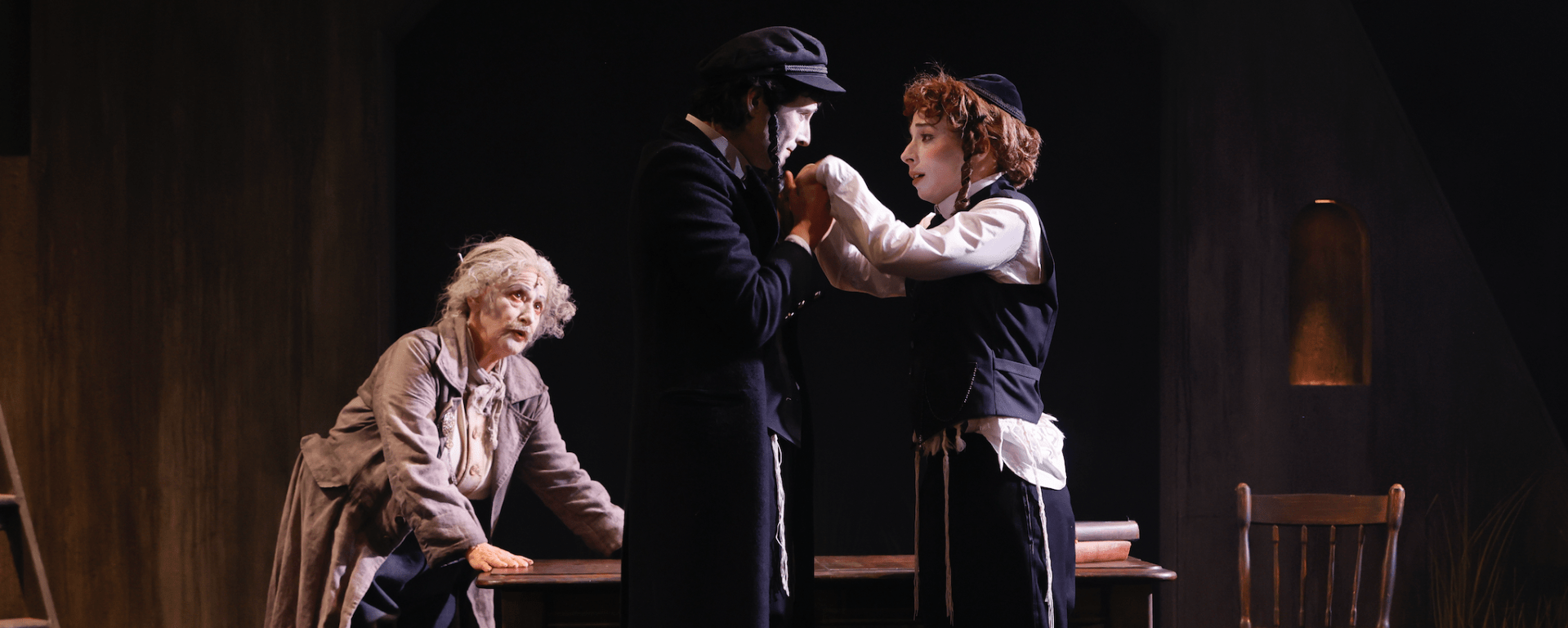
Before I go on and mention the rest of the cast, mainly Genevieve Kingsford as Hodes and Ashley Margolis as Avigdor, let’s quickly talk about the staging and the setting in themselves. From beginning to end, the auditorium is very dark, the walls of the stage are painted black and most of the props and furniture are sombre. Yentl themselves are mostly dressed in black, in the customary male clothing, but do wear a white shirt, which they will undress to when they are the most vulnerable or fighting with their own mentality. The Figure wears earth tones, highlighting their role as a metaphorical presence rather than a physical one.
In contrast to that, Hodes, the only character truly identifying as a woman, wears colour and changes her dresses and hair. She is possibly the only character who knows truly who she is and what she wants; opposite Yentl and her study companion Avigdor, who are both struggling to find their place and accept themselves. All characters wear white makeup on their face, which, as explained by the co-writers, is, on one hand, an homage to Yiddish Theatre’s tradition and, on the other, a way to showcase that everyone wears a mask. Isn’t that true for us all, even today? Every detail in that production is so well thought out and meaningful; it has to be one of the best plays I’ve ever had the chance to witness.
Going back to our small cast of only four – yes, four! – I was equally as mesmerised by Avigdor’s fervent personality and Hodes’ kindness. Both characters are driving elements in Yentl’s journey and sexual discovery. But they both have their own journey and learnings along the way. Margolis was astounding in portraying the duality of Avigdor, alternating between playing him as full of life and a depressed and melancholic man. The way he feels so comfortable around Yentl makes us love him even more as we get to see more of him, including his vulnerability and adoring facets.
Hodes is also very lovable from the moment we get to meet her. Her passion for Avigdor and then her respect and confidence around Yentl allow us to see a woman of multitudes. She is not only a wife or a daughter, but the show also makes sure to depict her as a character with her own personality, charms and thinking. Although her dreams and desires are very different from those of our protagonist, she still remains an essential representation in our society.
Yentl doesn’t shy away from complicated or tough conversations. It exposes the gritty truth unfiltered, whether it is about discovering your own sexuality, being torn between two identities, acknowledging what is right and what feels right, challenging faith and traditions, all the while being faced with an unwelcoming world. It is not a place to feel ashamed, or embarrassed, or even shocked by the crude commentary, but a place to listen and watch and learn.
Yentl shows us that we all have a fire inside of us ready to be unleashed. Yentl makes us question our reality and search for more. Yentl is a powerful and thought-provoking tale about becoming who we are truly meant to be in the midst of adversity. Yentl is the play we need right now.
 curtaincallbway.com