
By Constance Drugeot
Pictures: Camilla Greenwell
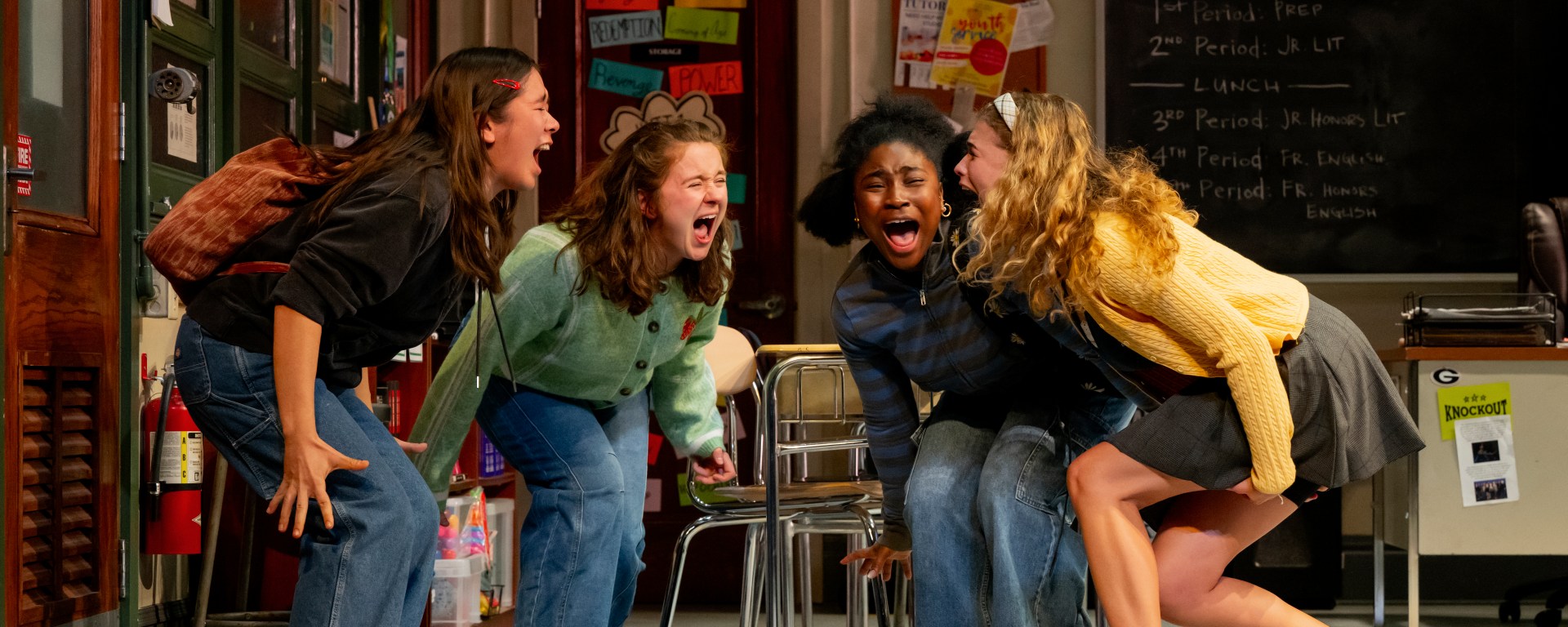
We had the great opportunity to chat with some of the young cast of the newly opened John Proctor is the Villain at the Royal Court Theatre. After a successful run on Broadway, the show transferred to London, opening on March 26th and running until April 25th. Amidst the raving reviews from across the pond, we were very excited to discuss the play with Clare Hughes (Ivy Watkins), Reece Braddock (Mason Adams), and Miya James (Raelynn Nix).
You just started previews, what has it been like working on this show?
Clare Hughes [Clare]: It’s been an incredible journey. I can’t believe I didn’t know the rest of the cast a month ago. The rehearsal process was so fun. The play itself is so brilliant. We’ve had Kimberly Belflower, our playwright, and Danya Taymor, our director, in the room the whole time. The energy in the room has been incredible. They really invested so much time in the first half of the day in ensemble-building and memory plays to help us get to know each other as people. We would do these explorations as our characters, and I think that immediately created a very warm atmosphere, because the whole point in the play is that these people have known each other their whole lives. It’s a small town, and you have no time to waste. Right from the get-go, we have to know their history. So, having a rehearsal process that revolved around creating those meaningful connections, I found it to be really liberating and not something I’ve really experienced before in a rehearsal process. So, I loved that.
Reece Braddock [Reece]: Every rehearsal process builds the lead up to performing the play, and it’s so vital to have those moments where you perform in front of an audience, because it really tells you what you need to add or to take away to the play, and what’s working or not. Because we’re very fortunate that the play is transferred from Broadway, we know it works well. There are, of course, going to be slight differences in the audience. Although from what I’ve heard from Danya and Kimberly, the audiences here have been as excited about the play and emotionally moved as they were in America. So, it seems it’s been doing the same job as Broadway, which is really nice to see. Last night, one of our stage managers told us that in the back row of the stalls, they all got up and danced with the characters at the end. That was just incredible.
Miya James [Miya]: Clare and I saw a mate of mine who’s actually from the States last night, and she was raving about it and really enjoyed the play. I chatted with her, and she said that it was really nice to see young American voices respected in British theatre. That doesn’t always happen. So it’s really cool. She seemed just so gratified that the play existed. Everyone’s very passionate about it. It’s beautiful.
Were you excited to tackle this show and material?
Clare: I didn’t get to see the show when it was on Broadway, but one of my best friends, Harry, was in New York and had seen it. He messaged me and was like, “Clare, I just saw this play. It’s changed my life. I’ve been listening to Greenlight nonstop. You have to read this play; you would love it.” So, when I saw it was being transferred over here, I wasn’t sure at the time whether they were bringing the Broadway cast with them, but I knew I wanted to do it. So, when the email came through, I was like, “Yes, yes, yes, yes!” Then, I read the play and fell in love with it. The rest is history. But I had heard about how incredible it was. I was glad I didn’t see it because my first access to the material was through my character lens. I think we can all attest to the fact that once you know who you’re playing, you read the play in probably quite a different way.
Reece: I hadn’t heard of the play until I got the audition. I also didn’t know how big a play it was at the time, as well, because in complete transparency, I’m still in my third year at drama school. So, at the time, I was doing one of my projects, which is when we do our show reels and radio reels. My agent said to me that she wanted me to put myself forward for a bunch of stuff, and she put me forward for it. When I read the script, I was just in awe of how well written it is.
It’s a testament to Kimberly because she’s one of the most intelligent people I’ve ever met. Her ability to articulate herself and how she feels about different things is so inspiring as a person. I think, as Clare said, the first time you read the play, you always read it through the lens of the character you’re going to play. Once I’d found that I’d got in the role, I’d kind of taken it upon myself to read it a few more times without that in mind and really appreciate the entirety of every character’s journey. I was just buzzing. I was so excited.
Miya: I think I’m in between. I’d heard of the play, but I didn’t really know what it was about. I read the script for the audition. Weirdly, I wasn’t actually originally in for Raelynn. So I was trying to read it from another character’s perspective, but my brain kept being like, “This is wrong”.
I’m glad it turned out the way it did. I remember reading the script, and my partner was in the room. Normally, I’m not a vocal responder or anything, but I was gasping! I was laughing, I was crying. He was like, “What is happening over there?” It’s just so brilliant. It’s so cool to get to be part of it.
Can you tell me more about your character and their storyline? What do you love most about playing them?
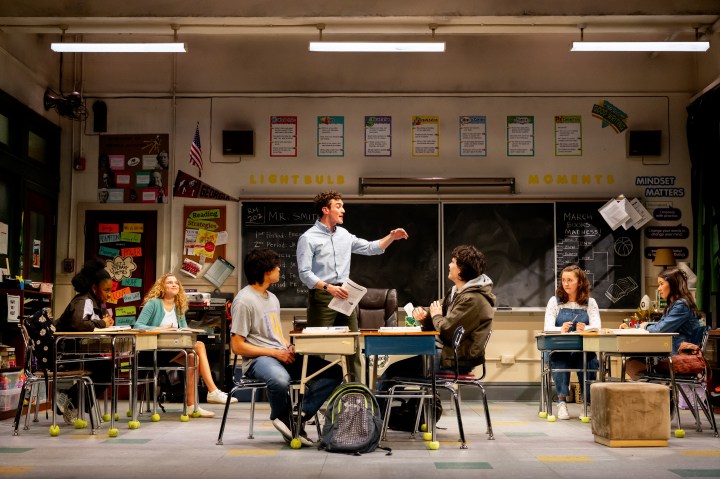
Clare: I love Ivy. Everyone in this play, in their own way, goes through a lot. I really admire her ability to retain her hopefulness, which I think, amidst everything, is so essential. I think she really beautifully embodies a woman who is carrying a burden that doesn’t belong to her.
All these characters are so young, which I constantly have to remind myself of. The play is set in 2018, which in my head isn’t long ago, but it was a different time. The thing that really struck me about Ivy is that she tries to see the good in everything. I found that to be really energising and endearing and quite sad. But I really like clinging to that. I just love her hope.
Miya: Ray is the preacher’s daughter, and she goes on a journey of discovery, finding her more goth side, no spoilers…! But she’s very much at the beginning of that journey. When you meet her at the top of the play, she is recovering from the biggest heartbreak of her life and is on this healing journey. When the play starts, it all gets cracked open again. She goes through this play trying to find her way through this insane situation that she’s been in. I think her story is about finding her voice and her agency and learning how to speak up for herself. I love her capacity for forgiveness, which is kind of amazing.
Reece: One thing I love about Mason is just his ability to keep trying. I think when I was in the audition with Kimberly and Danya, I remember asking Kimberly, “Why did you write Mason in this story?” She said that she wanted to write a character who is given the freedom to make mistakes and learn from them. I think the reason why Mason is in the play and why I love him so much is that you see him make mistakes throughout the play, pretty much in every scene. And yet he’s allowed to redeem himself and try again. I think that that’s something as human beings we should all allow ourselves to make mistakes and try. I think that he does that really well. I love Mason’s arc. His journey is one that I’ve grown to love.
The show tackles deep topics such as power, gender equality and inequality, and female sexuality and independence through the study of Arthur Miller’s The Crucible. Why do you think it’s important to bring this story to the stage right now?
Reece: I’m going to quote Dónal Finn right now. We just finished our first run through of the play, and we were discussing theatre in general. And one thing that Dónal said, which I got him to write in my notebook, is “theatre is there to make the comfortable disturbed, and the disturbed feel comfortable.” I think what this play does is allow those who have experienced something like this in the modern day to feel seen. There have been many times when Kimberly or Danya have had people come up to them and say that they’ve had a similar situation happen to them. It has allowed them to be seen. I think it’s there to bring people together. And that’s why I think Dónal Finn is incredible.
Clare: I think it’s essential for so many reasons. I actually was my character’s age in 2018. So a lot of the references and the world of it felt incredibly real. I think the depiction of girlhood and friendship feels incredibly messy and raw, but also silly and funny. I love how seriously the girls are taken, because I think it’s so easy to reduce how you feel at that age. But that’s when your feelings are the biggest and most expansive, and you’re experiencing heartbreak and loss and earth-shattering things for the first time. Young people are often undermined. So, I think celebrating young people this way is so cool. The moments of complete joy and silliness and laughter and skipping are just as essential as the moments that are breaking your heart open. Just to have that often in the same sentence, laughter and tears, next to some of the things that we discuss in this play, feels so revolutionary and cool to me.
Miya: Everything they said! There are so many big themes, like finding power within a system that wasn’t built for you. I feel like teenage girls are so often portrayed as either just really mean or as the bullied ones. It’s not always the case, but it’s so often. And in this play, they all love each other. They all genuinely love each other. The situation is so rough, and they’re finding their way through it. So it gets messy, but no one is mean. Everything comes from love, which I think can be so true at that age.
What do you want people to take away from the story when they leave the theatre?
Clare: There’s a brilliant quote in the play that I love, which is “I contain freaking multitudes”. I often feel like that when I read the play. Going back to what Miya was just saying about how there are no mean characters. Because my character is from a wealthy background, there’s a way you could play her, and in the character description, it says, “resist the urge to play her as a mean girl”, which I loved. I think what the play does is that every single character has moments where they mess up. It doesn’t mean they’re a bad person. It just means that life is crazy. And they’re all trying. Life is all that; it can be that messy and joyous and euphoric and devastating all at the same time. The play captures that and what it is to be messy.
Miya: I think one thing Kimberly would want young people to take away would be to question the world that they were brought up in. Don’t be afraid to ask questions and to think, “But is that true?” Just because I’ve been told it my whole life, “Is it true?” And to love your friends and be there for them always.
Do you have a favourite scene to act or watch?
Reece: I have to say the last scene of the show is definitely my favourite, and I think it just speaks for itself. It’s so incredible just being able to sit there and be a part of it.
Clare: There are honestly so many moments, definitely the end, but I really enjoy, like when I’m in the wings, and I love listening to the audience and how they respond. Some really sticky points in the play feel so tense. We’ve had a few people be like, “Oh no, no, no!” Vocalising how they feel, which I always think is hilarious and beautiful because it’s what theatre’s meant to do. But there are several pin-drop moments, and I think they’re very disarming. We have these little vignettes throughout the show called “girl focuses / inside scoop”, where we, as the actors, acknowledge the room we’re in and that we see the audience. I feel like they’re really cool moments because you welcome the audience in and you acknowledge that they’re there. Some kind of witchcraft is embedded in the fabric of the show, and I think there’s something really special and crackly and cool about that. The moments where the audience is moved to speak or gasp or feel disarmed are really powerful.
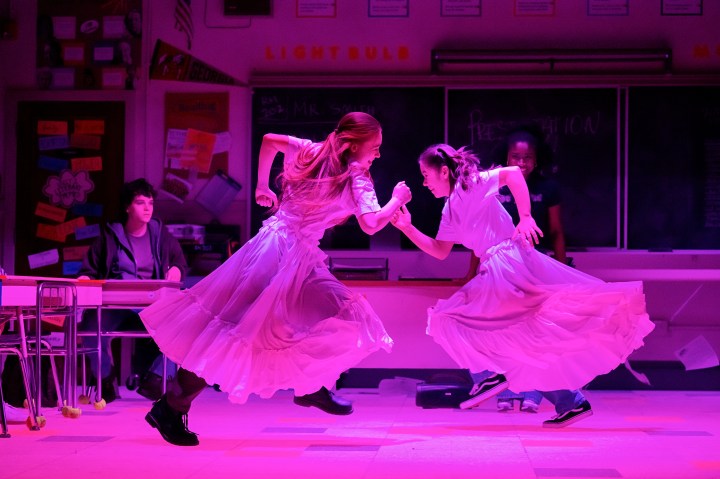
Miya: I think there are quite a few moments where the girls just get to be silly together. I don’t think it’s a spoiler, but we all have a little sing for a brief moment or a giggle. You get to see how when you’re 16, you’re simultaneously like 7 years old and also 25. You’re caught between these two things. They’re constantly switching between talking about politics and then singing Taylor Swift and dancing around. I really enjoy that.
What would you say to people to convince them to see the show?
Clare: I feel like there’s no convincing needed, honestly, that’s just so good. It’s so funny, and it’s so devastating and beautiful, and it’s an incredible night of theatre.
Reece: It has everything you need in a play, and there are moments of laughter, there are moments of crying, there are moments of shock. The reason why you’ve got to come watch it is that it has everything.
Clare: Also, we’ve been speaking a lot about younger audiences, but we’ve chatted to a few much older people, and they were feeling so nostalgic. That feeling of being nostalgic for a time you weren’t living through or weren’t that age. I’ve chatted with audiences much older, and they just find it really fascinating to actually get to see like an inside scoop into a world that’s foreign to them in some ways, but is also like, “Oh, wow, women have been skipping and singing and cackling with each other forever.” And that was the same when they were kids. I think it’s all very universal and relatable. If people say that they haven’t read The Crucible, then they can’t watch, it’s not true. It doesn’t matter. It’s very accessible to anyone.
Miya: If I were to convince someone who really likes The Crucible, and they’re scared that this is going to pick it apart. Danya, the director, and Kimberly, the writer, love The Crucible. I love The Crucible. I think most of us in the company love The Crucible. This isn’t an anti-Crucible play. It’s about setting it in a different context and seeing what can happen. And I find that really exciting.
Three words to describe the show?
All: Euphoric. Epic. Educational.
 curtaincallbway.com