
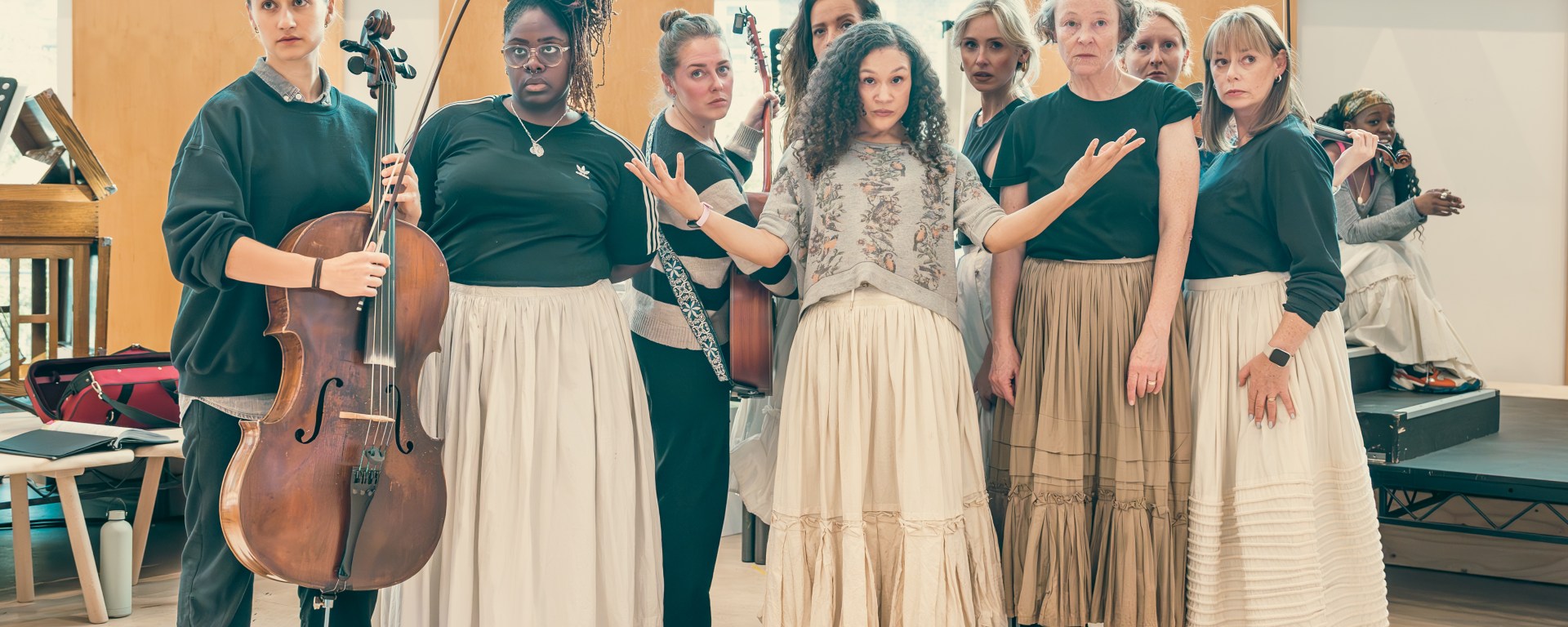
By Constance Drugeot
Pictures: Marc Brenner
Ahead of their opening at the Kiln Theatre, we had the exciting opportunity to chat with the creators of Coven, Rebecca Brewer (book, lyrics, music) and Daisy Chute (lyrics and music). The show explores the Pendle Witch Trials through the eyes of women of the time and is told by a female-only cast.
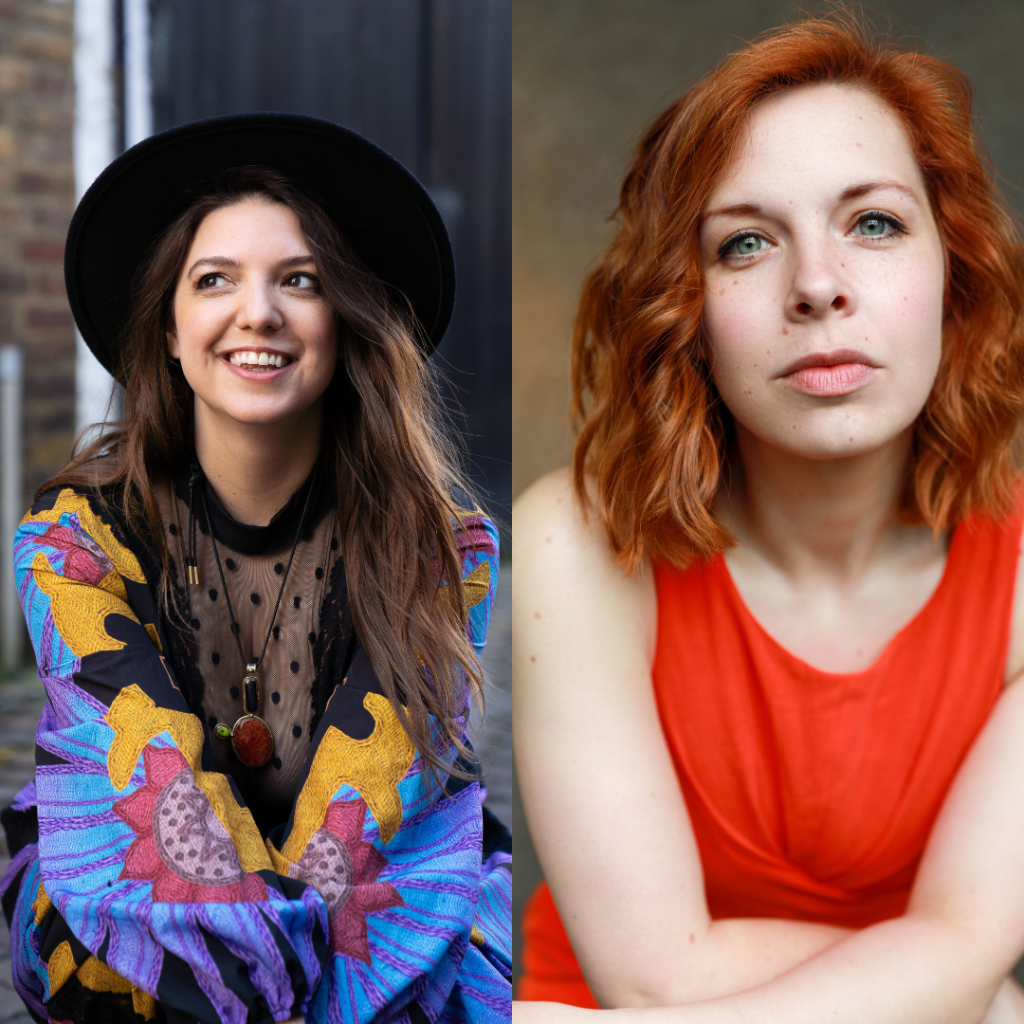
The show is opening very soon at the Kiln Theatre. How are rehearsals going?
Daisy Chute: Good. It’s scary because tomorrow, we have tech. I’m predominantly a performer and a singer-songwriter in the music world, so this is all quite new and exciting, and I’ve been told that tech is really hard. I think this show will be even harder than some because in musicals, there’s so much going on.
Rebecca Brewer: I’ve done lots of tech before. I’ve worked as an actor for 15 years. I’m trained to do musicals. This is totally my jam. But normally, I’m on stage as opposed to in the audience doing this. That’s been really thrilling to me. It’s such an exciting process to finally get to see the show take shape. I went into the theatre for the first time this morning, saw all the actors on the set, and it felt just like Christmas!
Daisy: Just seeing the set instead of being imagined on a mood board or a screen makes it more real!
Rebecca: This is the great thing for Daisy and me because we started the show about eight years ago, and it was just the two of us, and we were performing in it as well as writing it. To now suddenly get this version of our dreams, to have this exist on such a massive scale with so many people involved, is just so thrilling. It’s been a long road to get from where we started to where we are now.
Have you been involved since the beginning, then?
Daisy: It was our project. It was an idea that Becky had, actually. She had the idea to write a musical about the Pendle Witch Trials. She brought me on as somebody in the music world who she thought would be a good fit.
Rebecca: I had this idea about eight years ago, and then Daisy and I had known each other socially, and I’d been to a bunch of her gigs. I really liked the style of her music. I thought that her sound would really complement the ideas that I was seeing in my head to bring this story to life. So, we started working together, collaborating, writing the music. We spent a long time just writing songs together on the theme of Witch Trials, as well as doing a lot of research. So everything we would read, we would write songs about it. There was a bunch of songs that existed before the show necessarily existed.
Daisy: It started like a concept album in a way. That was also because of how I was used to working, but also how it worked with our schedules and our budget. We had to keep it manageable at the beginning, and we would get gig opportunities and musical theatre showcase nights. They would give us little deadlines along the way to create something new. So, they were always in a song form. It was the easiest thing to do together at that point. Then it became a bit more narrative, especially when we were asked to perform it at the Queen’s Theatre in Hornchurch. They gave us an hour-long slot, and suddenly we had to thread something else, and actually make it into a narrative, which is when we turned it more into what we called a “TED talk with songs”. So it became more informative with our own personal histories and relationships with witches and witch trials woven into it.
Rebecca: Through writing and gigging these songs, we would always share a bit of the history with the audience. This “TED talk with songs” emerged really naturally. Like Daisy said, there were only two of us at that point, and we didn’t really have any budget necessarily to have other people. But we wanted to keep working on the show, and we kept getting these opportunities to share the work. We kept getting positive feedback from the audience, so we carried on. Then we got to Queen’s Theatre in Hornchurch and we got a little bit of budget. We were able to bring in a violinist and a cellist to play on the songs with us and be part of the show. The form at that point was like a “gig meets a history lesson”. We finished that version of the show, and we gigged it around a couple of times. We got a great slot at the Edinburgh Fringe, but that was spring 2020. Then COVID happened, and it all got halted. Everything just stopped before we’d even got a chance. So then we had some time away from it.
Daisy: Which was actually the best thing we could have had because if we had done it in Edinburgh, we would have done it, and then we would have moved on to something else. It gave us time to rework it, so we decided to apply for Arts Council funding to see if we could develop it more and bring in other creatives. We started getting shadow puppetry involved, sound healing, and all sorts of other influences. We started to create a bigger world and a visual world around the show. We were introduced to the theatre producers, Kindred, who are now our partners with the Kiln Theatre. They allowed us to have a bigger budget and to imagine what it could be if it wasn’t just two of us but actually thirteen, and create a full narrative-driven story going back to Pendle, which was our initial idea to begin with.
What inspired you to make a musical about this topic?
Rebecca: This is the story of Jenet Device, who is the nine-year-old girl at the centre of the Pendle Witch Trials. I didn’t grow up near Pendle, but I knew of this story. Because of how I’d grown up in a semi-rural community in the north of England, I hadn’t always seen that experience lived out on stage in the rich and multi-layered way that I know it to be from personal experience. Other musicals like The Hired Man by Howard Goodall made me feel really seen because of how it showed the richness of working-class rural life. But that’s also very male, and it’s very much about money and finance, and I felt something was missing. So, I was looking for a story that could explore themes like rurality, femininity, community, folklore, and nature. And I saw this Simon Armitage documentary on the BBC about the Pendle Witch Trials, which sparked the idea eight years ago. When we partnered up with Kindred, we knew we had this version, which is like the history lesson, and they were really interested in that. We were so excited to be able to have the possibility to make this bigger version. So we set to work.
Daisy: Then we got other creators involved at that point. That’s when we had Morgan Lloyd Malcolm come onto the show for a bit, and she helped us with the development and gave a fresh perspective.
Rebecca: There’s still a lot of the old version that lives in this new version, but it felt really hard to reimagine it alone. And so, Morgan came on board and really helped to find the characters and unlock the structure. I think one of the most exciting discoveries for us, although it’s a terrible discovery for the actual person it’s about, was that Jenet Device, this nine-year-old girl who accused her family of witchcraft, finds herself accused of witchcraft by a child 20 years later. She is a nine-year-old who set the precedent for using child testimonies in court. They didn’t really use child testimony in court before that. Then, her actions come back, and she has to face them in a very real and terrible way. When the same thing happens to her, the accuser becomes the accused. It was that kind of element of the cycle and setting things in motion that just felt really theatrical as a concept. Especially because the wider themes that we’d researched as part of the oldest sort of history lesson version. Songs that were very much about the cycles that created the witch trials in the first place: the enclosure act, environmental issues, the divide between Catholics and Protestants… All of these things that were creating the hotbed for the witch trials and stoking division in communities, suddenly, they were able to turn these people against each other.
Daisy: Of course, women weren’t really given much power at this time, but one of the only ways women could own land was if their husbands died. So these older ladies in society had actually more power than some of the men, and this sparked jealousy. There’s an agenda going on around that, and then it was a way of getting rid of difficult women.
I love the fact that it’s a cast of only women with a mostly female-led creative team! I think it’s essential to tell a story about women, their power, narratives, and community. Why do you think it’s important to tell this story right now?
Rebecca: I think that’s something we found in the industry as well. We certainly need more stories about women. We found out recently that only 0.5% of recorded history is about women. That’s crazy when you think about it like that. But it does make sense, as recorded history is 99% male. It’s bad. So, let’s keep writing stories about women!
Daisy: We don’t have enough stories about women, but also from women who have that lived experience. We’re talking about the 1600s, but actually, a lot of the themes are still sadly relevant today. Some of the things to do with women’s bodies and healthcare, and women’s right to choose, have been a topic of conversation recently, and laws have changed to give women less power over those choices. Sadly, these are experiences that women are the experts to speak on, so it really needs to be a kind of female-led creative team as much as the cast as well. There are some triggering things for people; there’s a lot of stuff that is emotional. It’s very difficult, but I think that it’s also very therapeutic in a way and cathartic to be able to tell a story and empathise with the people who were telling.
Rebecca: So much of these witch trials, the history of it was recorded by the people who were on the side of the witch hunting and making money from it. So, there are questions about how unbiased those historical accounts may have been. There’s a really nice spirit of reclamation in having so many women telling this story and being able to interrogate the history and what’s been written previously.
How did you decide what the score would sound like? How did you structure the writing around the music?
Daisy: That’s a really good question. Becky has done the book, and we’ve both done the music and lyrics. I’ve been more involved in the arrangement and instrumentation. One thing for us that was quite a learning curve was going from this concept album form with individual songs into the much more narrative-driven songs. It’s been an interesting process to learn the best way to tell the story and to choose which moments are the moments for the characters to sing. In terms of the actual genre, what felt right for each character was unique, and it needed to serve the story without being too homogenous with our sound world. So, now the genres have been quite wide-ranging. We go from quite folky ballad-y music to an Americana and rootsy stuff, but also we go quite rocky. We also go quite country in a kind of comedy way. We have a parody of a boy band number, which is trying to show the ludicrousness.
Rebecca: Edmund Robinson is the little boy who accuses Jenet of witchcraft. We found his original testimony online, and it is hundreds of pages of the wildest stuff. He talks about going out with his friend Henry and eating some wild plums. Then what follows is this bizarre story about Janet twiddling her thumbs at him and burning flesh in a barn, and it’s crazy. And yet the courts weren’t like, this kid has eaten some dodgy plums in the forest, and he’s clearly had some sort of hallucinogenic trip. No, they went, “Oh, so she must be a witch”. This is the absolute madness of some of the accusations that were levelled at women, and of course, had a very serious impact, but the way that we have dealt with that is to show how crazy they are by making them into huge comedy numbers. A lot of the lyrics that are in that rap were inspired by his original testimony that we found from the 1600s. So, the musical world of the show is very rich and vast. Originally, when it was Daisy and me, we would write a lot of music using loop pedals to create more voices. Now, we don’t need to create more voices because we have more actual voices, but there’s still an element of that kind of repetition.
Daisy: One of the themes of the looping is the nine-year-old Jenet, who’s basically coerced by the magistrate Roger Knoll. So, the looping is the repetition of that testimony, but it becomes fractured at different times because her memory is unreliable. The show is all about different versions of that story. We’re influenced by elements in the music as well. The show is about witches and a woman during this time. We’re talking a lot about the elements such as earth, water, fire, air and spirit. These are all woven into the show’s themes, with different characters representing different elements at times. We have our very earthy Martha, who is a woman of the land. She knows soil and she’s green-fingered, and then we have our Maggie, who’s the healer, and she’s more spiritual. The elements are also represented in the visual and the sound design.
Rebecca: So over the years, some songs from the early days have fallen by the wayside, and then some of them have been updated and, it’s been such a amazing process for us to take these songs and test them out in this narrative world and see what we need to do to fix them and see if they even still exist in this version. It’s been great. We’ve loved writing the music for this show!
Daisy: Every time we get a brief to write a new song, it’s always been exciting, and now that we won’t have that anymore, I’m going to be sad.
Rebecca: I know. It’ll be so weird when we don’t have to write music for this anymore. I don’t know who I’ll be (laughs).
Do you stay involved with the show once it opens?
Daisy: Oh yeah. We’ll still be in the room watching it and feeding back, but there’s a certain amount that we have to hand off as well. There needs to be a moment when we release the actors of our many changes.
Rebecca: But also, I think about how great this process has been. It started with the two of us, and then, the more people we brought on board, the richer the project became by becoming infused by other people’s creativity. It’s still very much our thing, but it also belongs to everybody who’s worked on it. So it’s going to be so exciting to see it and watch it!
Daisy: Which is quite a transition for us, obviously, as performers, so I think I have no idea of the feeling I’ll have when it goes up next week for the first time, but I know I’ll be like, “What do we do? What do we do with all this adrenaline?” We haven’t got any out there. We have to just sit there.
What are you most excited about when it opens, and when people are going to discover it on stage?
Rebecca: I’m just excited to sit amongst an audience. Watch it and see what happens. The beauty of this project is that we’ve always just followed what felt right instinctively. So the next thing and the next thing and the next thing. There’s no way eight years ago, when it was just the two of us writing music in Daisy’s flat and gigging it in Borough Market, we could have imagined being here at the Kiln with this incredible team. It’s the journey for us. I don’t even know how to describe it. It’s taken over nearly a decade of our lives. I’ve had two children while we’ve been making this (laughs). That’s how long we’ve been doing it! I’m just so excited to sit amongst other humans that haven’t travelled this journey. I will learn what the show is when we have more members of the Coven in the audience watching it; it’s a community, essentially.
Daisy: That’s what theatre is. We’ve had a taste of some of the audience reaction from our old versions, but also just in the room whilst the other creative team came to see it and heard it for the first time. And the response is so visceral. It’s really emotional. I think I’ll probably cry about 10 times when I see it.
What would you like people to remember from the show and the story?
Rebecca: I guess it’s always been about this question of what is a “witch”, and that is a really big question. Growing up, this story of the Pendle Witches was very much like, “oh, they were witches and they did spells”. Actually, there’s so much more to the story than that, which is about scapegoating, coercion, people dying as a result of people in power stoking, creating division for their own gain. Witchcraft is so many different things to me. It means so much to me in so many different ways. I would love for people to come sit amongst other people and just have an experience, and consider that sort of question about the word “witch” and what comes into your head when you hear the word “witch”.
Daisy: Hopefully, we’ll plant some seeds in people to think about these people in history as people and not symbols, and about the ramifications, the knock-on effects of what happened and the patriarchal systems that we find ourselves in, which have just created a lot more division and war and hate. Hopefully, people will realise that actually we can do it better, maybe we can do it differently.
How would you describe the show in 3 words?
Rebecca: Ultimate Goddess Power.
Daisy: I want to say fire. Because it’s fiery, it’s the creative and destructive element of fire. What else? Cycle. I would like to say words that are just disparate, like Fire, Cycle, and Release. It’s a release. A release from shame, a release from the history that we’ve been taught.
If you had to convince someone to go see Coven, what would you tell them?
Rebecca: Come and see a brand new musical with thirteen incredible women on stage, brand new music, and a fresh interrogation of an old story.
Daisy: With really good tunes, they’ll be singing them as they leave. It’s anthemic, it’s rousing, it’s inspiring. And it’s part of our history that we don’t really talk about a lot. It’s informative. Hopefully something we can learn from.
Coven runs until January 2026. You can purchase your ticket here!
 curtaincallbway.com